
tank cleaning chemicals manufacturer UAE
Tank Cleaning Chemicals Manufacturer UAE: Industry Standards, Certifications and Applications
Tank Cleaning Chemicals Manufacturer UAE: Industry Standards, Certifications and Applications
The United Arab Emirates has established itself as a global hub for chemical manufacturing, with a particular strength in specialised industrial cleaning solutions. RXSOL, a leading tank cleaning chemicals manufacturer UAE, supplies mission-critical formulations to the oil and gas, marine, petrochemical and utilities sectors across the GCC region. As businesses in the Middle East face increasingly stringent regulatory requirements, evolving environmental standards and complex operational challenges, selecting the right tank cleaning chemical partner has become a strategic decision rather than a simple procurement task. This comprehensive guide explores the landscape of tank cleaning chemicals manufacturing in the UAE, the certifications and standards that define quality, and how locally manufactured solutions deliver superior performance compared to imported alternatives.
The UAE Tank Cleaning Chemicals Manufacturing Sector: Overview
The UAE chemical manufacturing sector has grown exponentially over the past two decades, transforming from a regionally dependent market into a self-sufficient, innovation-driven ecosystem. Within this broader landscape, tank cleaning chemicals manufacturer Abu Dhabi operations form a crucial specialisation, particularly given the emirate's status as a global energy hub. Abu Dhabi hosts major oil production, refining and downstream facilities, creating constant demand for high-performance cleaning solutions for crude oil tanks, fuel storage vessels, and production equipment.
Similarly, tank cleaning chemicals manufacturer Dubai facilities serve a thriving port infrastructure, ship repair yards, and trading operations that depend on reliable tank cleaning to maintain vessel compliance and operational efficiency. The strategic location of these manufacturers enables rapid supply-chain response, same-day or next-day delivery to major industrial clusters, and the ability to customise formulations to address regional operational challenges such as high ambient temperatures, high-salinity environments, and the presence of stubborn hydrocarbon deposits common in Arabian Gulf oil fields.
RXSOL operates within this ecosystem with a manufacturing footprint across the UAE, combined with an extensive network of distribution partners and technical support teams positioned throughout the GCC. The company's competitive advantage stems not merely from geographical proximity to customers, but from deep technical knowledge of regional challenges, compliance familiarity with local environmental regulations, and the ability to maintain consistent stock levels of critical products without import delays.
The UAE chemical manufacturing sector is regulated by the General Authority of Islamic Affairs and Endowments (GAIAE), the Ministry of Climate Change and Environment (MOCCAE), and the Emirates Conformity Assessment Accreditation System (ECAAS). These regulatory bodies enforce stringent standards for product quality, environmental safety, and workplace protection. For UAE chemical manufacturer oil gas operations like RXSOL, compliance is non-negotiable; it forms the foundation of customer trust and enables participation in major tender processes across the energy sector.
Key Standards for Tank Cleaning Chemical Manufacturers
Manufacturing and distributing tank cleaning chemicals in the UAE requires adherence to a multilayered framework of international and regional standards. Understanding these standards is essential for any commercial buyer evaluating potential suppliers, as they directly impact product safety, environmental compatibility, regulatory acceptance and long-term liability protection.
ISO 9001 Quality Management System
ISO 9001:2015 certification is the foundational requirement for any credible tank cleaning chemicals manufacturer UAE-based operation. This standard establishes a comprehensive quality management system covering product design, manufacturing processes, quality assurance, corrective action procedures, and continuous improvement protocols. RXSOL maintains current ISO 9001 accreditation, which means all tank cleaning formulations are produced under documented procedures, subject to batch testing, and backed by certificates of analysis (COAs) that verify chemical composition, pH, density, and performance parameters.
REACH Regulation and Chemical Safety
The European Union's REACH (Registration, Evaluation, Authorisation and Restriction of Chemicals) regulation has become a de facto global standard for chemical product safety, particularly in industries that export to or import from Europe, or that serve multinational corporations with global compliance frameworks. Although REACH is an EU regulation, its requirements increasingly influence specification decisions across the GCC region, especially in oil and gas companies with international parent companies or certification obligations.
Tank cleaning chemicals must be evaluated for hazards to human health and the environment, and this information must be communicated clearly through safety data sheets (SDS) and product labels. RXSOL formulations comply with REACH requirements and are supported by comprehensive safety documentation that enables customers to implement appropriate handling procedures and meets their own regulatory obligations.
GHS and CLP Labelling Requirements
The Globally Harmonised System (GHS) for classification and labelling of chemicals is increasingly mandated across UAE and GCC countries. GHS provides a standardised framework for hazard classification (acute toxicity, chronic health effects, physical hazards, environmental hazards) and uses consistent labelling elements including pictograms, signal words and hazard statements. The EU's Classification, Labelling and Packaging (CLP) regulation is the European implementation of GHS and is often referenced in GCC regulatory contexts.
For tank cleaning chemicals, proper GHS/CLP labelling ensures that end-users, safety officers and emergency responders understand the chemical's hazards and can implement appropriate protective measures. A reputable tank cleaning chemicals manufacturer UAE facility will provide fully compliant labels in both English and Arabic, reflecting local regulatory requirements.
UAE Environmental and Safety Regulations
The UAE's Federal Law No. 24 of 1999 on Environmental Protection and Development establishes mandatory environmental standards for chemical handling, storage and disposal. The Ministry of Human Resources and Emiratisation (MHRA) enforces occupational safety standards that apply to workers handling tank cleaning chemicals. Additionally, some emirates impose their own supplementary requirements; Abu Dhabi's Department of Municipalities and Transport (DMT) and Dubai's Municipality include specific provisions for hazardous substance handling in industrial zones.
Tank cleaning chemicals manufacturers must demonstrate that their products meet these standards and that their manufacturing facilities operate under approved waste management and environmental protocols. This regulatory landscape means that choosing a local manufacturer with established compliance credentials reduces customer liability and ensures alignment with evolving local requirements.
API and NACE Standards for Oil and Gas Applications
For tank cleaning chemicals used in crude oil storage, fuel processing and drilling operations, alignment with American Petroleum Institute (API) and National Association of Corrosion Engineers (NACE) standards is essential. API RP 2013 covers inspection of refinery and terminal equipment, while NACE standards address corrosion prevention and materials compatibility. Although these are international standards, they are routinely specified in contracts for GCC oil and gas operations, particularly by major multinational operators.
Manufacturers must ensure that their alkaline and acid tank cleaning formulations do not cause undue corrosion on carbon steel, stainless steel or aluminium surfaces common in tank construction. This requires rigorous testing and transparent documentation—exactly the kind of assurance that a certified tank cleaning chemicals manufacturer Abu Dhabi facility can provide through batch testing and corrosion rate data.
RXSOL's Manufacturing Credentials and Quality Systems
RXSOL's position as a trusted tank cleaning chemicals manufacturer UAE is built on decades of operational expertise, continuous investment in quality systems, and a commitment to transparency that extends from raw material selection through to final product delivery. The company's quality infrastructure reflects best practices in chemical manufacturing and goes beyond minimum regulatory compliance.
In-House Manufacturing and Quality Control
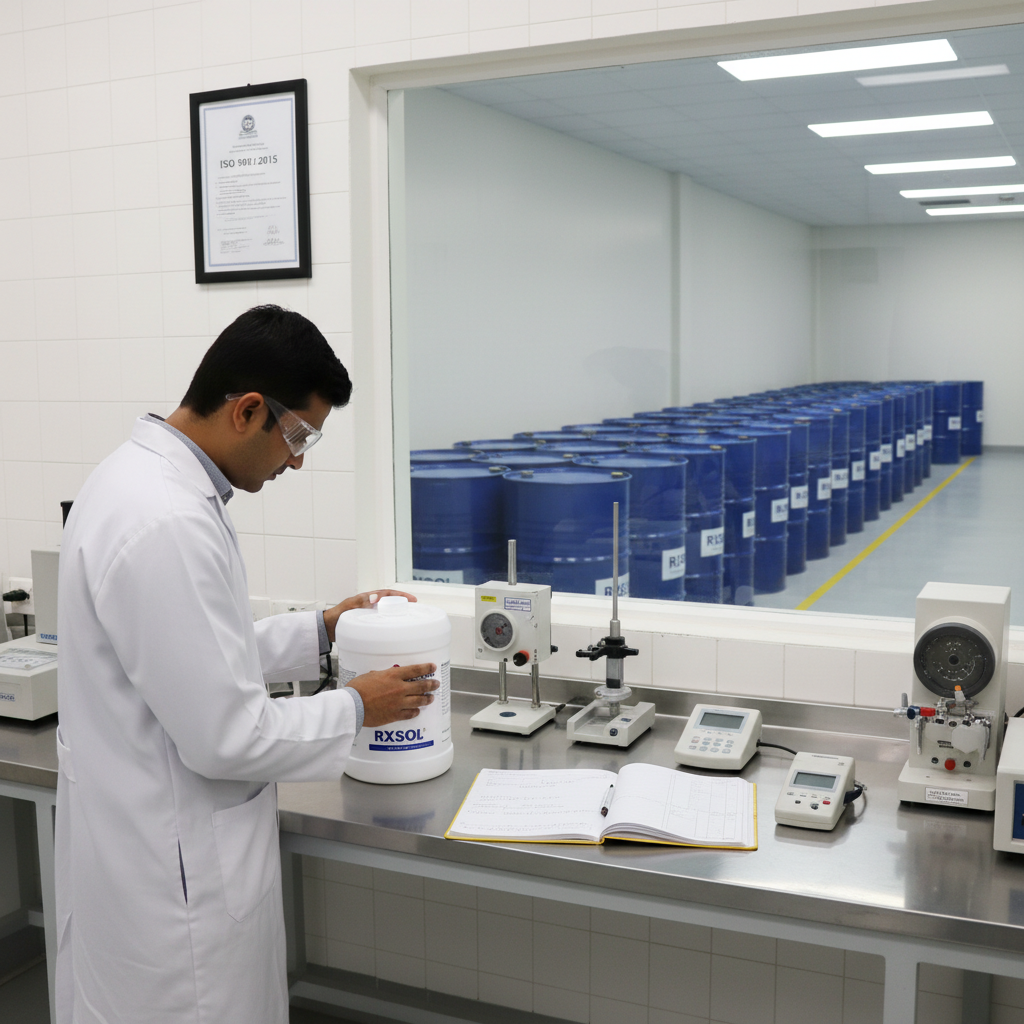
RXSOL operates dedicated manufacturing facilities for tank cleaning chemistry, equipped with mixing, blending, storage and testing equipment designed to produce consistent, high-purity formulations. Every batch of Alkaleen Tank Clean Safety, ECOSOLV 222 ACID FRAC TANK CLEAN, and other core products undergoes comprehensive quality control testing before release. This includes pH verification, density checks, viscosity measurement, and performance validation against specification. The company maintains a quality management laboratory with trained technicians and calibrated analytical instruments, ensuring that products consistently meet declared specifications.
Certificate of Analysis and Full Documentation
Every shipment of RXSOL tank cleaning chemicals is accompanied by a comprehensive Certificate of Analysis (COA) that documents key chemical parameters, test dates, batch numbers, and compliance confirmation. This documentation is critical for customers who must maintain audit trails, comply with their own quality systems, or provide evidence of product conformance to regulators or parent company standards. The COA includes pH readings, active ingredient concentration, density values, and a statement of conformance to relevant standards.
Additionally, RXSOL provides Safety Data Sheets (SDS) in both English and Arabic, technical bulletins explaining optimal application procedures, and Material Safety Information that enables customers to implement appropriate storage, handling and disposal protocols. This commitment to documentation reflects the company's understanding that customers purchasing tank cleaning chemicals are not merely buying a product—they are acquiring a complete technical solution backed by transparent, auditable information.
Raw Material Sourcing and Supply Chain Transparency
The quality of tank cleaning chemicals begins with careful selection of raw materials. RXSOL sources active ingredients, surfactants, chelating agents and other components from established chemical suppliers with their own quality credentials. The company maintains vendor qualification procedures that verify supplier certifications, audit critical suppliers periodically, and maintain multiple supply sources for critical raw materials to ensure continuity of supply.
This rigorous supply-chain approach protects customers from the risk of contaminated or off-specification feedstocks that could compromise final product performance. For buyers in the UAE evaluating different tank cleaning chemicals manufacturer options, supply-chain transparency is a key differentiator—it indicates whether a manufacturer is simply blending and repackaging commodity chemicals, or genuinely controlling and validating the entire production chain.
Technical Deep-Dive: How Tank Cleaning Chemicals Are Formulated
Tank cleaning chemicals fall into two primary categories—alkaline formulations for hydrocarbon removal, and acid formulations for scale and mineral deposit dissolution. Understanding the chemistry behind these products enables buyers to select the right solution for their specific tank and contamination profile.
Alkaline Chemistry and Saponification
Alkaline tank cleaning chemicals rely on a process called saponification, in which strong alkali (typically sodium or potassium hydroxide) reacts with fatty acid chains in crude oil, fuel residues and other hydrocarbon deposits, converting them into water-soluble salts (soap). Alkaleen Tank Clean Safety exemplifies this chemistry; it combines hydroxide alkalinity with specialised surfactants that enhance emulsification, allowing the saponified hydrocarbons to disperse uniformly in the cleaning solution rather than coalescing into separated layers.
The alkalinity level (typically pH 11–13) is carefully balanced to maximise saponification efficiency while minimising corrosion risk on tank surfaces. The addition of corrosion inhibitors protects steel and other metals from excessive attack during the cleaning cycle. Modern alkaline formulations like Alkaleen Tank Clean Safety also incorporate chelating agents that bind trace metals and prevent them from catalysing oxidation reactions that could degrade the formulation or precipitate unwanted residues.
The advantage of alkaline chemistry is its effectiveness on fresh and used motor oil, crude oil, bitumen, and many organic contaminants common in fuel and hydraulic fluid tanks. The disadvantage is that alkaline solutions are ineffective against mineral deposits, scale and rust—contaminants that accumulate over years of storage or operational use.
Acid Chemistry and Chelation
Acid tank cleaning formulations address contamination types that resist alkaline treatment: iron oxide scale, calcium carbonate deposits, rust, and other mineral precipitates. ECOSOLV 222 ACID FRAC TANK CLEAN is formulated with organic acids (typically citric, acetic or phosphoric acid) that dissolve mineral scales by protonating carbonate and oxide species, converting them to soluble salts. To prevent the acid from attacking steel surfaces excessively, chelating agents (such as EDTA or aminopolycarboxylates) are incorporated; these preferentially bind iron and other metal ions, keeping them in solution and preventing them from catalysing corrosion.
Acid formulations are particularly valuable in fracturing tank cleaning applications (as the name ECOSOLV 222 indicates), where proppant residues, mineral scale and rust must be removed from tanks that will subsequently receive proppant slurries. The chelation chemistry ensures controlled pH profiles that dissolve minerals without damaging tank integrity.
The limitation of pure acid chemistry is that acids do not saponify hydrocarbons effectively. Modern tank cleaning approaches often combine alkaline pre-cleaning (to remove organic deposits) with acid post-treatment (to remove remaining mineral scale), or use hybrid formulations that incorporate both alkaline and acidic components to address mixed contamination profiles.
Surfactants and Emulsification
Surfactants are the workhorses of tank cleaning chemistry. These molecules have both water-loving (hydrophilic) and oil-loving (lipophilic) sections, allowing them to bridge the interface between water (the cleaning solution) and oil (the contaminant). By accumulating at the oil-water interface, surfactants reduce interfacial tension, enabling water-based cleaners to penetrate and disperse oil droplets that would otherwise remain as separate phases.
RXSOL formulations incorporate carefully selected surfactant blends that achieve rapid emulsification without excessive foaming—excessive foam can interfere with circulation, reduce cleaning efficiency and create safety hazards during tank ventilation. The choice of surfactant type (anionic, cationic, nonionic or zwitterionic) affects compatibility with alkaline or acid bases, effectiveness on different hydrocarbon types, and biodegradability in wastewater treatment systems.
Performance Additives and Stabilisers
Beyond active cleaning chemistry, tank cleaning formulations include performance additives: anti-corrosion agents that protect steel and aluminium, anti-foaming compounds that prevent excessive foam, water-hardness chelators that enable cleaning efficiency in areas with high mineral content in rinse water, and biocides that prevent microbial growth in stored cleaning solutions. These additives are selected and balanced to create a stable, shelf-stable product that maintains its cleaning power over months of storage in UAE warehouses and customer facilities.
Applications: From Crude Tanks to Air Coolers and Deck Cleaning
Tank cleaning chemicals serve diverse applications across the oil and gas, marine, petrochemical and utilities sectors. Understanding the specific requirements of each application guides correct product selection and effective deployment.
Crude Oil Storage and Fuel Tanks
Crude oil tanks and fuel storage vessels accumulate sediments, scale, and viscous residues that must be removed during routine maintenance or prior to tank re-commissioning. Alkaline formulations like Alkaleen Tank Clean Safety excel in this application, quickly saponifying crude oil and fuel residues into water-soluble salts that can be rinsed away. The alkaline pH inhibits corrosion during the extended contact times required for heavily contaminated tanks, and the surfactant blend ensures rapid emulsification and separation of oil from the tank walls.
Selection of alkaline vs acid cleaning depends on the tank's contamination profile. A tank storing paraffinic crude will respond well to pure alkaline treatment. A tank that has accumulated years of sediment and has internal rust or scale will benefit from sequential alkaline-acid treatment: alkaline for organic removal, followed by acid to dissolve mineral deposits and clean the steel surface.
Fracturing Tank and Production Equipment
Hydraulic fracturing operations generate substantial contamination in the tanks that hold proppant slurries and fracturing fluid returns. These tanks must be thoroughly cleaned between jobs to ensure product separation and prevent cross-contamination. ECOSOLV 222 ACID FRAC TANK CLEAN is specifically formulated for these demanding applications, providing aggressive acid cleaning chemistry that dissolves proppant fines, mineral deposits and rust without damaging tank surfaces. The chelation system ensures that dissolved metals remain in solution and do not redeposit on clean surfaces, leaving the tank ready for the next job.
The name "frac tank clean" reflects the product's primary market, but the chemistry is equally effective on any tank that has accumulated mineral scale, proppant residue or oxidised surface deposits.
Marine and Ballast Tank Cleaning
Ships engaged in crude oil trading or fuel transport must periodically clean their cargo tanks to maintain vessel class certification and prepare for different cargoes. Tank cleaning chemicals suitable for marine applications must function effectively in seawater rinse conditions (where dissolved salts complicate the cleaning chemistry), be environmentally benign enough to meet International Convention for the Prevention of Pollution from Ships (MARPOL) discharge standards, and be cost-effective at the scale of large ship tanks (often 30,000+ tonnes capacity).
RXSOL tank cleaning formulations used in marine applications are formulated to maintain cleaning efficiency even in high-salt-content rinse water, and to biodegrade rapidly in marine environments, reducing environmental risk. The company works closely with ship operators, terminal facilities and vessel classification societies to ensure compliance with the stringent environmental and safety standards that govern marine tank cleaning operations.
Air Cooler and Heat Exchanger Cleaning
Air Cooler Cleaning Chemical LT addresses a specialised but critical application: removing scale, biological deposits and hydrocarbon fouling from the finned tubes and headers of air-cooled exchangers used in offshore platforms, refineries and power generation facilities. Air coolers are continuously exposed to seawater spray and atmospheric contamination, accumulating mineral scale and biological slime that progressively reduces heat transfer efficiency and can lead to operational shutdowns.
The Air Cooler Cleaning Chemical LT formulation is designed to circulate through tight tube geometries, penetrating mineral deposits and dissolving them without requiring extended soak times (which would extend downtime). The chemistry is mild enough for repeated use without degrading gasket materials, yet aggressive enough to remove stubborn salt deposits and biological material common in Gulf coast environments where high temperatures and humidity accelerate fouling.
Deck Washing and General Equipment Cleaning
Deck Washing Powder extends tank cleaning chemistry into broader industrial cleaning applications. Formulated as a dry powder that is dissolved in water at the point of use, Deck Washing Powder provides cost-effective cleaning for ship decks, platform surfaces, equipment and piping contaminated with oily residues, grease and accumulated dirt. The powder format offers logistical advantages—reduced shipping weight, simplified storage, and the ability to reconstitute at application strength, reducing waste of over-concentrated solutions.
On vessels and offshore platforms where space is constrained and multiple cleaning tasks compete for resources, versatile products like Deck Washing Powder enable operators to maintain cleanliness standards across diverse surfaces without maintaining separate product inventories.
Why UAE-Manufactured Tank Cleaning Chemicals Outperform Imports
Buyers evaluating tank cleaning chemicals face a fundamental choice: import established brands from major international suppliers, or source locally from manufacturers like RXSOL. This decision has implications for cost, supply reliability, technical support, and regulatory compliance that extend far beyond simple unit price comparisons.
Supply Chain Reliability and Rapid Availability
Imported chemicals, however well-established, are subject to international shipping delays, customs clearance, port congestion and logistics variability. In the UAE and GCC, where many industrial operations run continuous schedules and tank cleaning often occurs as unplanned maintenance in response to operational issues, supply delays translate directly to operational downtime and revenue loss. A local tank cleaning chemicals manufacturer UAE facility maintains finished goods inventory distributed across multiple warehouses, enabling same-day or next-day delivery to major industrial clusters in Abu Dhabi, Dubai, Sharjah and throughout the GCC.
RXSOL's inventory management ensures that critical products like Alkaleen Tank Clean Safety and ECOSOLV 222 ACID FRAC TANK CLEAN are available immediately, reducing customers' need to maintain large safety stocks and freeing up capital for other operational priorities.
Customisation and Responsive Technical Support
Imported tank cleaning chemicals are typically formulated for generic applications and cannot be rapidly adapted to address region-specific challenges. A tank in the Arabian Gulf operating at 50°C ambient temperature, contaminated with Arabian crude oil having specific wax and asphaltene characteristics, and filled with high-salinity formation water, presents cleaning requirements that differ materially from a North Sea tank or a US Gulf Coast facility.
RXSOL maintains technical teams with deep knowledge of regional hydrocarbon chemistry, local water composition, and operational practices. When a customer faces an atypical cleaning challenge, RXSOL's technical staff can evaluate the contamination profile, recommend a tailored approach combining products in the portfolio, and even formulate specialised variants if standard products prove insufficient. This responsiveness simply is not available from distant international suppliers.
Cost Advantages and Bulk Pricing Flexibility
Imported chemicals incur substantial costs for ocean freight, customs duties, import licences and insurance. These costs are ultimately passed to end customers. A tank cleaning chemicals manufacturer Abu Dhabi operation eliminates these import-related expenses, reducing the base cost of the product. Additionally, local manufacturers can offer greater pricing flexibility on bulk purchases, recognising that large orders contribute to capacity utilisation and supply certainty.
For large integrated oil and gas operators, petrochemical facilities and ship repair yards that consume thousands of litres of tank cleaning chemicals annually, sourcing from a local manufacturer often results in unit costs 15–30% below imported equivalent products. Over a year, this represents substantial savings while maintaining or improving product quality.
Regulatory Compliance and Audit Support
Tank cleaning chemicals purchased locally come with full compliance documentation prepared by manufacturers familiar with UAE and GCC regulatory requirements. When customers undergo audits by health and safety authorities, environmental regulators or parent company auditors, the availability of Arabic-language safety documentation, local manufacturing credentials, and established quality certifications simplifies compliance demonstration.
Furthermore, when regulatory requirements evolve—as they periodically do across the GCC—local manufacturers are typically among the first to adapt formulations and documentation. A manufacturer like RXSOL, with established relationships with regulatory bodies and continuous monitoring of regulatory developments, can ensure that product updates are implemented promptly, protecting customers from the risk of regulatory drift.
Environmental and Sustainability Considerations
Sourcing tank cleaning chemicals locally reduces the carbon footprint associated with international shipping, aligning with the UAE's Sustainable Development Goals and corporate sustainability commitments increasingly embedded in customer procurement policies. Additionally, RXSOL formulations are optimised for regional disposal and wastewater treatment infrastructure, ensuring that post-use cleaning solutions can be treated effectively in local facilities rather than creating disposal challenges that would result from incompatible international formulations.
Many large customers now include supplier sustainability metrics in their procurement evaluation. A local manufacturer's ability to demonstrate minimal shipping impact, optimised product disposal chemistry, and compliance with UAE environmental standards increasingly influences purchasing decisions, particularly among multinational operators with global sustainability targets.
Knowledge Transfer and Operational Optimisation
When purchasing from a local manufacturer, customers gain access to ongoing knowledge transfer regarding optimal tank cleaning practices, emerging applications, and operational efficiency improvements. RXSOL's technical team regularly engages with customers, understanding their specific operational challenges and recommending improvements in cleaning procedures, equipment selection, and product application that can enhance results and reduce costs.
This collaborative approach contrasts with transactional relationships with distant international suppliers, where knowledge flows primarily in one direction (purchase order to product delivery). Over time, the continuous improvement opportunities enabled by local manufacturing partnerships accumulate into significant competitive advantages for customers.
The case for sourcing tank cleaning chemicals from a tank cleaning chemicals manufacturer Dubai or Abu Dhabi operation is compelling when evaluated comprehensively. While imported products may have established brand recognition, local manufacturers increasingly match or exceed international quality standards while delivering superior supply reliability, cost efficiency, regulatory alignment and technical support.
Navigating Your Tank Cleaning Chemical Procurement Strategy
For commercial buyers tasked with sourcing tank cleaning chemicals for industrial operations in the UAE or GCC, the decision framework should incorporate several key evaluation dimensions. First, validate that potential suppliers maintain relevant certifications (ISO 9001 as a minimum, and ideally API or NACE standards for oil and gas applications). Second, request comprehensive documentation including Safety Data Sheets in both English and Arabic, Certificates of Analysis for recent batches, and references from existing customers in comparable industries.
Third, evaluate responsiveness and technical capability by engaging directly with the manufacturer's technical team. Discuss your specific contamination profiles, operating conditions, and compliance requirements. A manufacturer that listens carefully and proposes tailored solutions is likely to be a more valuable partner than one that simply recommends standard products.
Fourth, compare total cost of ownership rather than unit price. A slightly higher unit price from a local manufacturer may result in lower total cost when supply reliability, rapid availability, customisation capability and technical support are quantified. Fifth, assess supply chain transparency and ask about raw material sourcing, quality control procedures and batch testing protocols. Manufacturers confident in their quality systems will welcome such scrutiny.
Finally, consider the strategic dimension: a partnership with an established local manufacturer like RXSOL creates opportunities for continuous improvement, knowledge sharing and collaborative problem-solving that extend beyond any single procurement transaction.
Request technical specs, COA and manufacturer pricing on tank cleaning chemicals from RXSOL UAE
Frequently Asked Questions: Tank Cleaning Chemical Manufacturers in UAE
Are tank cleaning chemicals manufactured in UAE or imported?
The UAE has a growing chemical manufacturing base, particularly in Abu Dhabi (ADNOC Industrial City — ICAD) and Sharjah (Hamriyah Free Zone), which produces some basic industrial chemicals. However, the majority of specialty tank cleaning chemicals supplied in the UAE — including RXSOL branded products — are manufactured by international chemical companies and either imported or locally blended. RXSOL operates manufacturing and blending facilities in India and distributes through its UAE network. Local formulation (blending of imported active ingredients to final specification) is also practiced by some UAE chemical companies.
What quality standards should UAE tank cleaning chemical manufacturers meet?
Reputable tank cleaning chemical manufacturers for UAE supply should hold ISO 9001 quality management certification, produce chemicals meeting relevant international standards (IMO MEPC guidelines for marine tank cleaning, ASTM test methods for performance), comply with UAE Federal Law No. 24 of 1999 on environmental protection, and maintain GHS-compliant Safety Data Sheets. For ADNOC operations, additional vendor qualification through iSCM (ADNOC's supply chain portal) is required.
What is the difference between a UAE tank cleaning chemical manufacturer and a distributor?
A manufacturer produces the chemical product from raw materials (either fully or through blending). A distributor sources finished products from manufacturers and resells them. In the UAE context, most chemical companies are distributors or trading companies rather than manufacturers of specialty tank cleaning products. Abu Dhabi Chemicals is a distributor and supply partner for RXSOL-branded tank cleaning products, providing local warehousing, technical support, and regional logistics that a foreign manufacturer cannot offer directly.
Can UAE chemical companies provide custom tank cleaning formulations?
Yes, for high-volume requirements. Custom formulation typically involves adjusting active ingredient concentrations, adding or removing specific components (fragrances, additional surfactants, corrosion inhibitors), or modifying physical properties (viscosity, pH, colour) to meet client-specific technical specifications. Minimum orders for custom-blended tank cleaning chemicals in UAE are typically 1,000 litres or more. RXSOL's technical team works with Abu Dhabi Chemicals to develop custom formulations for specific client requirements across the UAE and GCC.
How do I verify the chemical quality of tank cleaning chemicals purchased in UAE?
Request a Certificate of Analysis (CoA) from the supplier, which specifies tested parameters against product specification limits. For critical applications, independent third-party testing through accredited UAE laboratories (TÜV Rheinland, SGS, Intertek) can verify product quality before acceptance. Abu Dhabi Chemicals provides CoA with all product deliveries and supports client testing requirements where needed.
Related Solutions & Products
Air Cooler Cleaning Chemical LT
Solvent emulsion cleaner for cleaning of Air coolers, Scavenging air systems and turbochargers of diesel engine.
Learn more →Alkaleen Tank Clean Safety
Non Caustic high quality product classified as a vegetable oil, animal oil, fat, fuel oil, lube oil and pet coke residues general remover/cleaner applied to cargo and storage tanks as well as to other systems.
Learn more →Deck Washing Powder
Heavy-duty alkaline deck washing powder for ship decks, cargo holds, and marine vessel surfaces. Removes oil, grease, rust, and cargo residues. Suitable for manual and mechanical application.
Learn more →ECOSOLV 222 ACID FRAC TANK CLEAN
Specially formulated for cleaning and fast-acting solvent cutter for tank plate etc, used for fuel oils. Also for local cleaning and degreasing of deck and engine rooms, Oil installations, workshops, plant yards, industrial plants as degreaser and cleaner
Learn more →Need Technical Assistance?
Our team of chemical engineers is available in Abu Dhabi and Dubai to provide dosage consultation and safety documentation.